

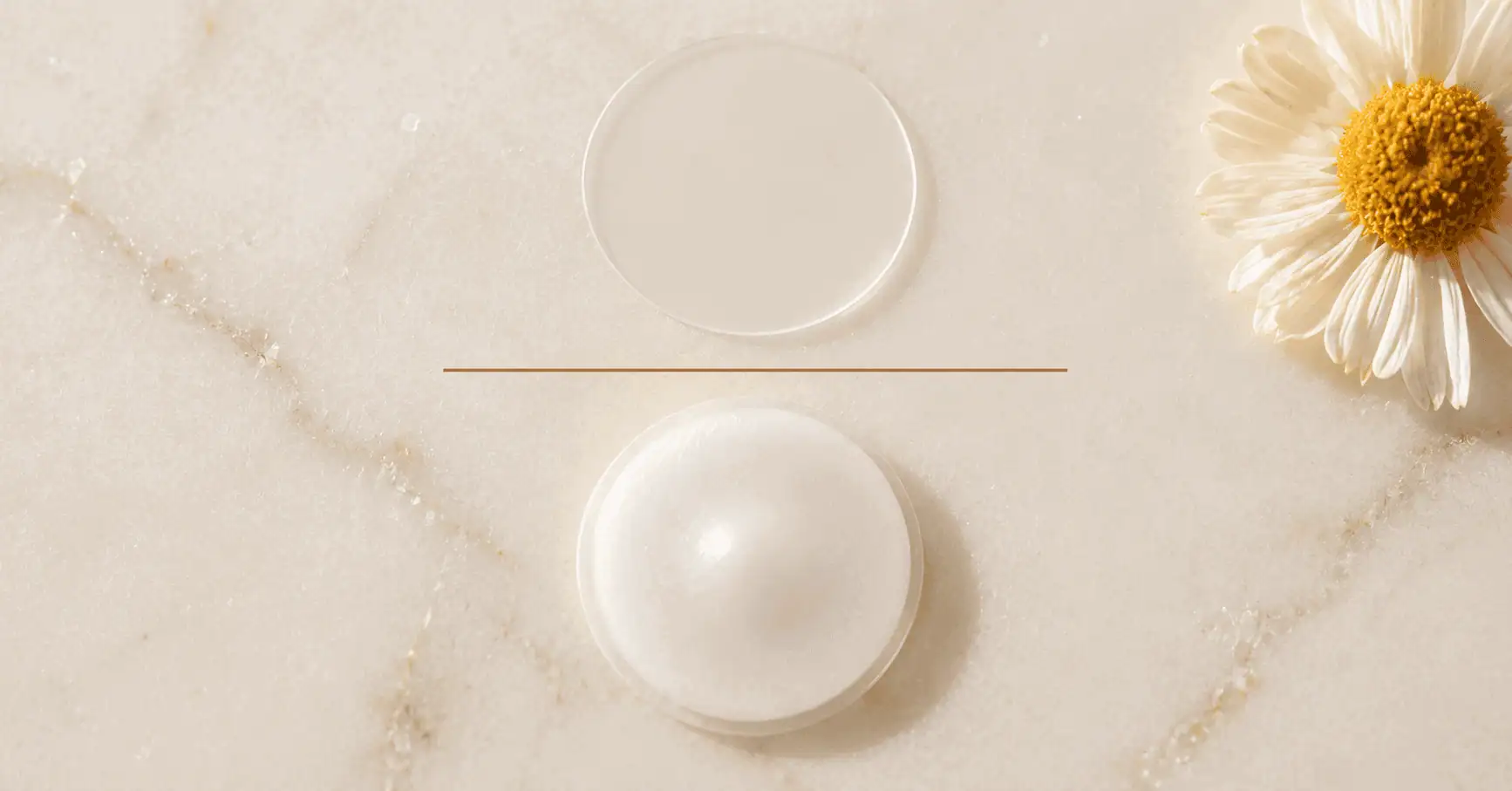

You wake up, peel back the patch, and there it is. It's opaque white and slightly domed, as if it absorbed half the pimple. Which it did. But have you ever wondered exactly why it turns white? Not just "it absorbed stuff." Rather, the actual physics of why a clear gel disc becomes a white dome. So here's the real science of why a pimple patch turns white overnight.

Understanding this changes how you read your results. In fact, the colour and shape of a used patch tell you exactly what happened overnight. They also tell you whether to apply another one.
The Science of Why a Pimple Patch Turns White
Fresh hydrocolloid gel is semi-transparent. That's because the carboxymethyl cellulose (CMC) polymer chains are compact and regularly arranged. As a result, light passes through the gel much like it passes through glass.
Then the gel absorbs fluid — pus, sebum, water, and dead-cell debris from the pimple. In response, the polymer chains swell and expand in all directions. This creates a disordered, irregular internal structure. Disordered structures scatter light. So instead of passing through cleanly, light bounces off the chains in random directions. That scattering is what produces the white, opaque look.
It's exactly the physics behind everyday white things. For example, clouds (water droplets scatter sunlight), milk (fat globules scatter light), and frosted glass. So the more the chains swell, the more fluid was absorbed. In turn, the more intensely white the patch becomes.
What Different Colours Tell You
This has a few causes. Maybe the pimple is deep (cystic, no surface exudate). Or it was already mostly drained before you applied the patch. Or the patch quality is very low (insufficient CMC). Either way, it still protected the area from contamination.
Some absorption occurred — typically from a smaller surface pimple or one with less fluid content. The pimple will be noticeably reduced but may benefit from a second night of patching.
Good extraction — the pimple had meaningful fluid content and the patch absorbed it well. The pimple beneath should be noticeably flatter and less inflamed. This is the typical result from a well-applied patch on an active whitehead.
Maximum absorption — the patch worked to full capacity. The pimple beneath may be nearly or completely drained. This is the ideal outcome. If the patch is very full, the pimple may benefit from a second patch.
Normal and actually positive — sebum (oil) is naturally yellow. A yellow tinge means the patch absorbed a significant amount of sebaceous material from the pimple. Not a sign of infection or irritation.
When to Change the Patch
Three clear signals tell you it's time to remove the patch:
- The patch is uniformly opaque white — maximum absorption has been reached. Leaving it on longer adds no benefit. Worse, it slightly raises the risk of skin maceration beneath.
- The patch has been on for 12+ hours — even if not fully saturated, 12 hours is the practical upper limit for most consumer patches. Beyond that, the adhesive loses integrity and the skin can over-soften.
- The edges are lifting — a patch that has partially detached has broken its seal. The absorption mechanism stops working once air enters under the patch. Replace immediately.
Is the pimple still active after the first patch — still fluid, still inflamed? Then apply a second fresh patch on clean skin. Repeat for up to three nights. Usually, most whiteheads clear by night two or three.
What You Should NOT See
Certain patch results indicate a problem:
- A ring of redness or irritation under the adhesive perimeter — possible reaction to the adhesive. Discontinue use. Choose a fragrance-free, minimal-ingredient patch.
- Skin appears whitened, wrinkled, and very soft beneath the patch — maceration. Usually, that's from leaving a patch on too long, or applying it to skin that wasn't fully dry. So remove it, then let the skin dry and recover before applying another.
- The pimple is significantly larger or more inflamed after removal — rare, but it can mean the patch was applied over broken skin that got infected. In that case, stop patching. Instead, treat it as an open wound and consult a dermatologist.
Frequently Asked Questions
How long does it take for a pimple patch to turn white?
The first signs of whitening typically appear within 2–4 hours on an active pustule. Full saturation (bright, uniform white) usually takes 6–10 hours. That depends on how much exudate the pimple holds and the quality of the patch. Overnight wear (8–12 hours) gives the most complete result.
Is it safe to leave the patch on if it's not white yet?
Yes. Even without active absorption, a clear patch still forms an occlusive barrier. So it protects the pimple from contamination and keeps a healing moisture environment. Leave it on for the full intended period, even if it hasn't whitened much.
Can I wear a second patch the same night if the first turned fully white?
Yes, but only under two conditions. First, the pimple is still active. Second, you can apply the new patch to completely clean, dry skin. So remove the first patch, rinse gently, pat dry, and wait 5 minutes. Don't apply a new patch if the skin beneath looks macerated or raw.
Why is my patch white but the pimple looks the same?
The whiteness confirms the patch absorbed material. However, the pimple may hold more fluid deeper in the follicle than one cycle reaches. So apply a second patch for another 8 hours. Most pimples need 1–3 cycles for full resolution. Each cycle extracts more and lowers inflammation.
Does a bigger white dome mean more pus was absorbed?
Yes, directly. The dome shape is the gel swollen with absorbed fluid. A large, prominent dome indicates a larger volume of exudate absorbed. A flat white patch indicates a smaller amount. The dome is satisfying for good reason — it represents material that is now in the patch and not in your pimple.
My patch is white but there's a clear liquid visible in it — is that normal?
Yes. Pimple exudate has two parts. First, the white cells and debris that make it opaque. Second, the watery serum that carries them. So you may see white areas (debris) and clearer areas (serum) in the same patch. That's normal, and it indicates thorough extraction.
Should I squeeze the patch to see how much it absorbed?
No. Squeezing it while adhered creates pressure. In turn, that can push absorbed material back down, or even rupture the pimple beneath. So remove the patch first. Then examine it all you like. That said, the contents are sealed in the gel and won't express.
Can I tell the difference between a good and bad patch by how white it gets?
To some extent. A patch with high CMC concentration will reach full whitening capacity and stay there. A cheap, low-CMC patch may show some whitening but plateau quickly, since the gel saturates fast and stops absorbing. So if your patch is consistently only slightly cloudy on active pimples, the CMC may be too low. In that case, switch to a higher-quality patch.
The Bottom Line
White means it worked. Specifically, the colour, shape, and intensity tell you how much material came out. They also tell you whether the pimple needs another cycle. A fully saturated, bright white dome isn't just satisfying. Really, it's a clinical signal that the patch did its job. So peel, examine, and if the pimple is still active, reach for a fresh one.
Medically reviewed guidance referenced from the American Academy of Dermatology and peer-reviewed research.